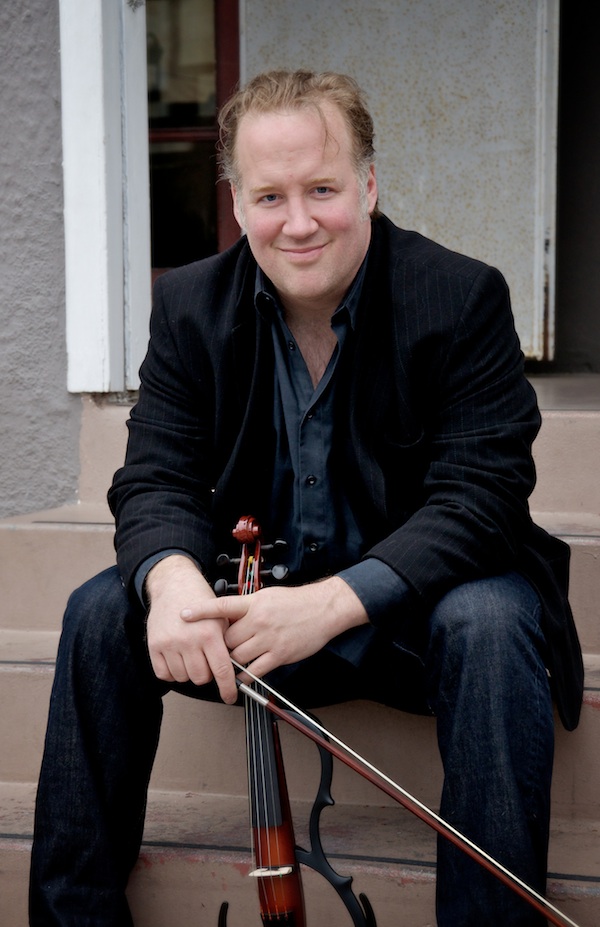
Want to learn how to play and improvise over Bad Bunny’s “MONACO” on violin? These two guided play-along lessons with Christian Howes give you an accessible way to hear the harmony, find useful notes, and build your own musical phrases—without memorizing a note-for-note solo.
Start with the easy call-and-response lesson, then continue to the advanced improvisation workout when you are ready for longer phrases and more creative freedom. Although Christian demonstrates on violin, the same process can work for viola, cello, and other melodic instruments.
Easy Bad Bunny “MONACO” Violin Play-Along
The easy lesson uses short call-and-response phrases. Listen to one idea, copy it, and then answer with your own variation. This format connects your ear, instrument, rhythm, and imagination without forcing you to solve everything at once.
How to practice with the easy lesson
- Begin with long notes. Listen for pitches that feel settled against the harmony.
- Copy the rhythm first. If the notes feel difficult, reproduce the shape and timing on one comfortable pitch.
- Use the D major and B minor pentatonic sound. These related note collections provide a practical starting point over the repeating harmonic framework.
- Change one detail. Repeat Christian’s phrase, then alter its ending, rhythm, register, or direction.
- Leave space. A clear musical answer does not need to fill every beat.
Advanced “MONACO” Violin Improvisation Workout
The advanced lesson moves beyond short imitation. Practice developing melodic cells, varying phrase length, changing your starting position, using rests intentionally, and creating ideas that carry across the form.
Ways to make the advanced workout productive
- Choose a small group of notes and create several different rhythms with it.
- Start phrases in different places instead of always entering on the first beat.
- Repeat a melodic cell before changing or extending it.
- Record one pass, listen back, and identify the strongest phrase.
- Trade between simple and active phrases so the solo has contrast.
Why this works for pop violin improvisation
Pop songs often use repeating harmonic loops. That repetition creates an ideal practice environment: instead of chasing many chord changes, you can concentrate on time, tone, phrasing, repetition, and variation.
The larger goal is not simply to learn one Bad Bunny song. It is to develop a repeatable process for hearing a pop progression and creating a violin part that sounds intentional. The same process—find a usable scale, hear the harmonic movement, build a rhythmic cell, repeat it, vary it, and leave space—can transfer to many other songs.
Take the next step: Bad Bunny, Kanye, and more
Christian’s Pop Violin Improvisation Course: Bad Bunny, Kanye & More expands this work into a 66-minute guided class. It begins with “MONACO” and its D major/B minor pentatonic framework, then moves to “American Boy,” featuring Kanye West, to explore the shift between E major and G major.
The course includes guided play-along exercises for multiple levels, a Pentatonic Extended Range Worksheet, major-scale exercises, and ongoing access to the expanding Pop Tunes collection.
Introductory offer: Use code POPTUNES30 to get instant access for $30 instead of the regular $65 price.
This independent educational lesson uses the harmonic framework of “MONACO” for improvisation practice. It does not provide or claim to be official sheet music or a note-for-note transcription.